Understanding the Complete Blood Count (CBC) Test – A Vital Health Check!
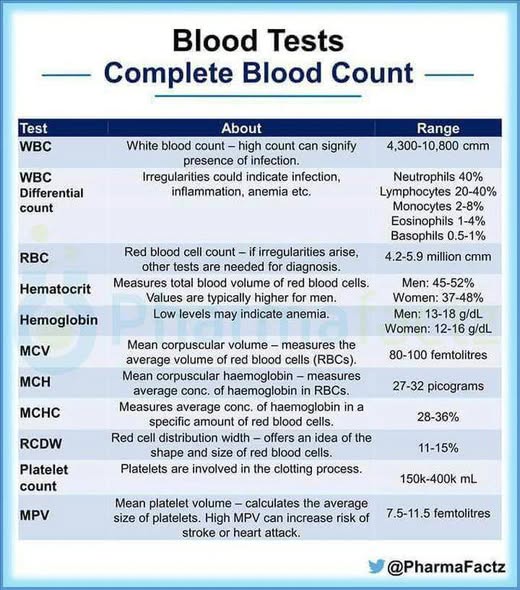
The Complete Blood Count (CBC) test is one of the most commonly used blood tests, providing critical insights into overall health. Here’s a breakdown of its key components and what they indicate:
 WBC (White Blood Cell Count):
 Measures immune response.
 High levels may indicate infection.
 Normal range: 4,300-10,800 cmm
 WBC Differential Count:
 Helps diagnose infections, inflammation, and anemia.
 Breakdown:
 Neutrophils: ~40%
 Lymphocytes: 20-40%
 Monocytes: 2-8%
 Eosinophils: 1-4%
 Basophils: 0.5-1%
 RBC (Red Blood Cell Count):
 Essential for oxygen transport.
Abnormal values may indicate anemia.
Normal range: 4.2-5.9 million cmm
 Hematocrit:
 Measures the proportion of red blood cells in blood.
 Normal ranges:
 Men: 45-52%
 Women: 37-48%
 Hemoglobin (Hb):
 A crucial protein in RBCs that carries oxygen.
Low levels suggest anemia.
Normal range:
Men: 13-18 g/dL
Women: 12-16 g/dL
MCV (Mean Corpuscular Volume):
 Measures the size of red blood cells.
Normal range: 80-100 femtolitres
MCH (Mean Corpuscular Hemoglobin):
 Indicates the average hemoglobin amount per RBC.
Normal range: 27-32 picograms
MCHC (Mean Corpuscular Hemoglobin Concentration):
Measures the concentration of hemoglobin in RBCs.
Normal range: 28-36%
 RCDW (Red Cell Distribution Width):
Assesses variations in RBC size, which can indicate anemia.
Normal range: 11-15%
 Platelet Count:
 Important for blood clotting.
Normal range: 150,000-400,000 cmm
MPV (Mean Platelet Volume):
Measures average platelet size.
 High values may increase stroke or heart attack risk.
Normal range: 7.5-11.5 femtolitres
Why is a CBC test important?
 Helps detect infections, anemia, blood disorders, and even early signs of serious conditions like leukemia.
A routine CBC test is essential for maintaining overall health and diagnosing underlying issues early.
 Stay informed about your health and encourage others to do the same!